Our Visit to the 19th ProRetina Meeting in Potsdam
Aktualisiert: 25. Apr. 2025
In early April, our group attended the annual PRO RETINA Research-Colloquium on Retinal Degeneration in Potsdam. It is a small and charming national conference that has become a beloved tradition for us. While it was already my fourth time attending, this year was special because three of our group members experienced it for the very first time.
Of course, no scientific trip is complete without a little road trip bonding. We kicked things off with a cheerful drive to Potsdam, complete with a classic traffic jam, a spontaneous lunch break at McDonald's, and plenty of music. Admittedly, with five people in the car and very different music tastes, we didn’t quite manage a democratic playlist, but let’s just say the ones who had control over Spotify set the vibe for the rest (Spotify playlist LabPlayer).
We presented four posters and enjoyed engaging discussions with other participants throughout the meeting.

Paula shared the first insights from her work within the CAMBio study, where she is characterizing extracellular vesicles in aqueous humor samples from both AMD patients and control subjects. Her poster focused on how storage conditions, drusen volume, and demographic factors might influence vesicle properties.
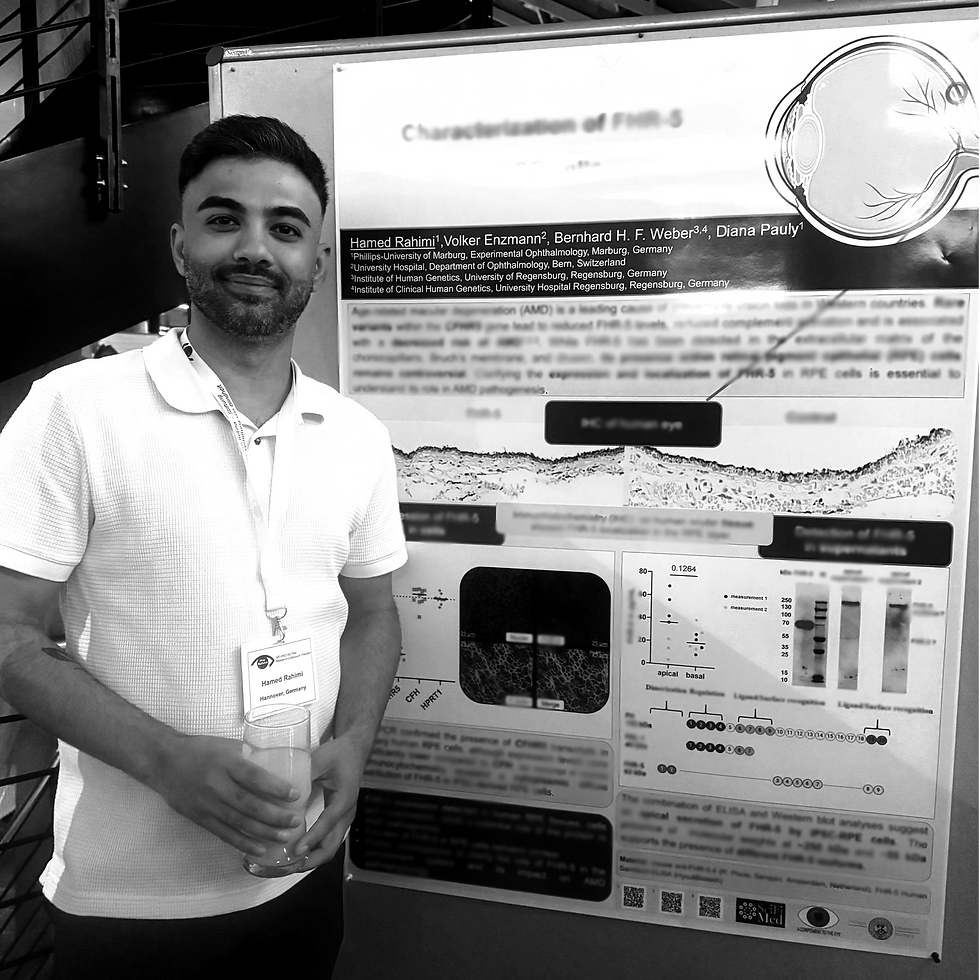
Hamed presented his observations on the expression and localization of FHR-5 in human retinal pigment epithelial (RPE) cells and tissue. His findings contribute to a better understanding of how this protein might play a role in retinal disease.

Caro showed her project plan, which centers on evaluating the specificity of anti-C3 antibodies. Her goal is to establish a reliable tool for future studies investigating complement activation in RPE cells.

And I presented results from my current project, which examines complement profiles and local C3 activation in the RPE, with an additional focus on how these processes are affected under TGF-β1-induced stress.
It was great to share these findings and exchange ideas with others working in similar fields!
The conference further featured a number of insightful and thought-provoking talks, including one on the molecular mechanisms of aging by Björn Schumacher and another on the genetics and therapeutic paradigms of retinal and macular degeneration by Anand Swaroop.
All in all, it was an exciting and inspiring experience, and I hope the conference and its intimate atmosphere will continue in the future!
Juliane
Addendum:
And of course we can't forget Aaron's contribution - without him, the sound of the entire conference would have been uncomfortable. He has become an integral part of ProRetina.


Kommentare